Methodology
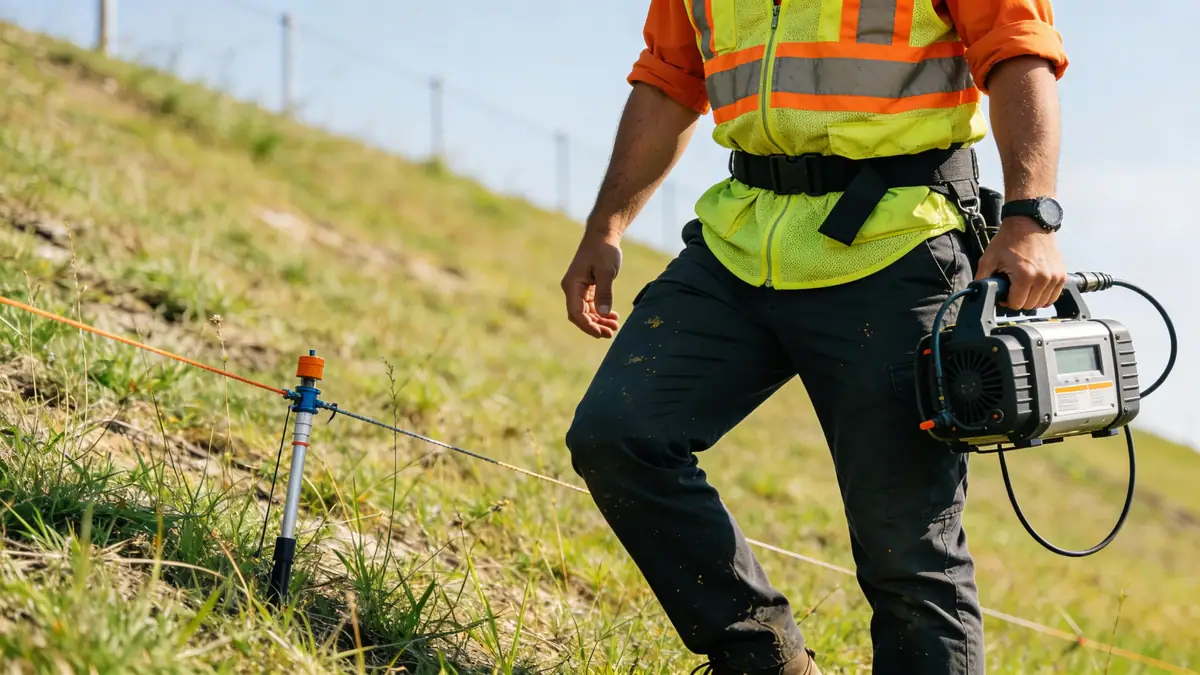
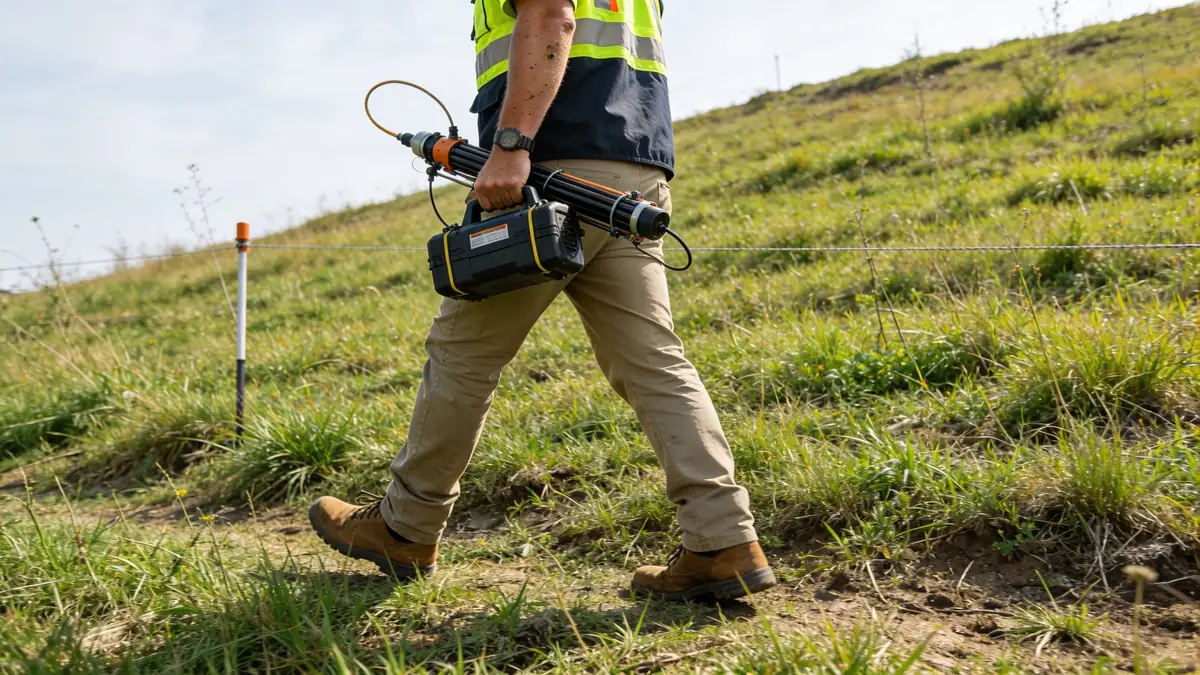
Our slope stability methodology follows a systematic, multi-phase approach. Initial site reconnaissance and historical data review inform a targeted subsurface investigation program, typically involving boreholes to depths of 10–30 m with standard penetration testing (SPT) per AS 1289.6.3.1. Soil samples are retrieved for laboratory classification (moisture content, Atterberg limits, shear strength via triaxial testing). We then develop 2D and 3D limit equilibrium models using software such as Slide2 and FLAC, incorporating parameters like cohesion (c'), friction angle (φ'), and unit weight. Pore pressure regimes are assessed using piezometer installations. For complex cases, we perform finite element analysis (FEM) to evaluate deformation and progressive failure. Our reporting aligns with AS 4678-2002 for earth-retaining structures and includes probabilistic risk assessments. This methodology is complemented by our SPT Boring services to obtain reliable soil strength parameters.
Reference Technical Parameters
| Parameter | Reference Value |
|---|---|
| Cohesion (c') | 0–150 kPa (typical range for Australian soils) |
| Friction Angle (φ') | 20°–45° (depending on soil type) |
| Unit Weight (γ) | 16–22 kN/m³ (unsaturated to saturated) |
| Factor of Safety (FoS) | 1.5 (static), 1.1–1.2 (seismic per AS 1170.4) |
Local Considerations — Australia
Australia's geological diversity demands region-specific slope stability considerations. In Adelaide, expansive clay soils on the Adelaide Plains require careful moisture monitoring to prevent shrink-swell movement. In Brisbane and the Gold Coast, residual soils over weathered rock (phyllite, schist) are prone to planar sliding along relict discontinuities. The seismic zones of Perth and Bunbury (AS 1170.4) necessitate pseudo-static analyses with horizontal coefficients up to 0.12 g. Our firm adapts each investigation to local conditions, leveraging a network of experienced geotechnical engineers in Adelaide, Brisbane, Perth, and other key cities. For example, in Ballarat and Bendigo, historical mining activity introduces void instability risks, requiring targeted geophysical surveys. We coordinate with local councils to meet specific development approval requirements.
Request a Quote
Our team reviews your project and issues an initial report at no cost.
Or write us directly at [email protected]
Applicable Standards
- AS 4678-2002: Earth-Retaining Structures
- AS 1170.4-2007: Earthquake Actions in Australia
- AS 1726-2017: Geotechnical Site Investigations
- Australian Geological Survey Organisation (AGSO) landslide hazard guidelines
Frequently Asked Questions
What methods are used for slope stability analysis in Australia?
We typically employ limit equilibrium methods (e.g., Bishop, Spencer) and finite element analysis per AS 4678. For critical infrastructure, probabilistic approaches are used to quantify uncertainty. Laboratory testing includes triaxial and direct shear tests to derive shear strength parameters.
Which Australian standards govern slope stability investigations?
Key standards include AS 4678-2002 for earth-retaining structures, AS 1170.4-2007 for seismic actions, and AS 1726-2017 for geotechnical site investigations. Local council guidelines may also apply, particularly in landslide-prone areas like the Gold Coast or Wollongong.
How long does a typical slope stability assessment take?
A standard residential slope stability investigation, including field testing and reporting, typically requires 2–4 weeks. Complex commercial projects with numerical modeling may extend to 8–12 weeks, depending on site access and regulatory requirements.
How much does slope stability analysis cost in Australia?
Costs range from $1,940 to $6,480 depending on site complexity, depth of investigation, and number of boreholes. Factors such as remote location, drilling difficulty, and required laboratory tests also influence pricing. We recommend requesting a tailored quotation.